The Complete Guide to the Single Elimination Tournament Format

Tournament formats shape the entire competition experience. They create structure, drive tension, and turn a long list of competitors into a clear champion. Among all formats used across sports, esports, school events, and community competitions, nothing is more common or straightforward than the single-elimination format.
If you have ever wondered what a single-elimination tournament is, how it works, or whether it is the right fit for your event, this guide breaks it all down with plain, practical clarity. We will cover its rules, benefits, drawbacks, strategy, and the best way to build a single-elimination tournament bracket that keeps everything organized.
Whether you are hosting a small office showdown or running a large competitive event, you will be fully equipped to run a smooth, fair, and exciting single elimination tournament.
What Is a Single Elimination Tournament?
Let’s start with the basic question: what is a single-elimination tournament? The idea is as simple as it sounds. Competitors are placed in a single bracket, and once they lose, they are out. Winners move forward and keep playing until there is only one player or team left. That final competitor becomes the champion.
You can think of a single-elimination bracket like a ladder. Everyone begins on the lower rungs, and each victory pushes someone higher until they reach the top. There are no second chances, no second bracket, and no extra lives. Every match carries weight.
People often use it because it is fast, easy to understand, and fair as long as the seeding is handled well. For viewers, it also creates a constant sense of urgency. Every game counts.

Source: faceit.com
Why So Many Events Use Single Elimination
A single elimination tournament removes a lot of the planning stress that comes with other formats. Here are the biggest advantages.
1. It is fast
Because players leave the bracket as soon as they lose, the number of matches is limited. A 16-player single-elimination format has only 15 total matches. A 32-player format has only 31. Compare that to round robin or pool play, where the match count explodes. When time is limited, single elimination is the easiest way to keep things moving.
2. It is simple
Everyone understands the concept behind a single-elimination tournament bracket. You win, you advance. You lose, you are done. Organizers, players, and spectators all stay on the same page. There is no confusion about tiebreakers, standings, or multiple rounds.
3. It highlights every match
In a single bracket, every game matters. There is no “warm-up round” or game that does not affect standings. This gives the tournament a natural sense of drama and momentum, which is why the format shows up in everything from local sports leagues to major esports events.
4. It works for any size
It does not matter if you have four players or four hundred. A single elimination bracket scales cleanly. You can seed competitors however you want, drop them into a single elimination tournament bracket, and run the event from start to finish with zero structural issues.
When Single Elimination May Not Be Ideal
Despite its strengths, this format also has a few drawbacks. Understanding them helps you choose the right system for your event.
1. One bad game ends a run
The biggest complaint about single elimination is that strong competitors can get eliminated early due to a single mistake or a tough draw. For events where fairness and ranking accuracy matter more than speed, formats like round-robin or double-elimination may be better.
2. Less playtime for participants
Once a player loses, their event is over. In a single-elimination tournament, some may play only one match. This can be a downside for events where participants traveled far or paid to enter.
3. Upsets can reshape the bracket quickly
Upsets are exciting, but they can also lead to anticlimactic finals if the strongest seeds eliminate each other early. This is another reason why careful seeding matters when you design a single-elimination tournament bracket.
Understanding the Structure of a Single-Elimination Bracket
A single elimination bracket follows a simple pattern, usually doubling at each stage until it reaches the final.
For example, you start with:
Round of 32
Round of 16
Quarterfinals
Semifinals
Final
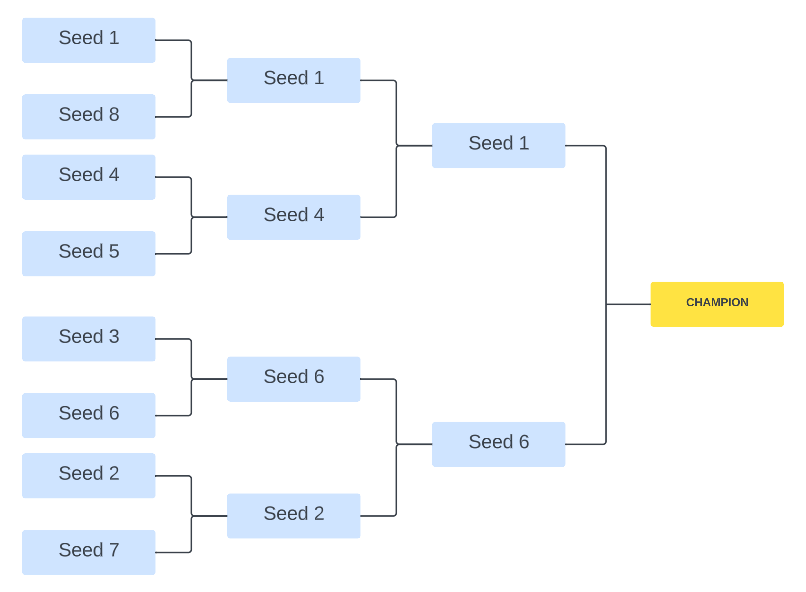
Source: lucidchart.com
Even smaller events follow the same pattern, just with fewer rounds.
Seeding
Seeding is the process of placing competitors in a single bracket based on skill, ranking, or another system. The goal is to avoid early matchups between top players. Good seeding protects the flow of a single-elimination tournament and helps ensure that the final rounds produce the most competitive matches.
Byes
If you have an odd number of competitors, some players receive “byes,” meaning they automatically advance to the next round. Most single-elimination tournament brackets use byes in the first round only.
How to Create a Single-Elimination Tournament Bracket
A strong bracket keeps everything smooth. Here is how to build one with confidence.
Step 1: List all competitors
Start with a complete list of everyone who will participate in the single-elimination tournament.
Step 2: Rank or seed each entry
If you care about competitive balance, seed the list from strongest to weakest. If not, you can randomize the order.
Step 3: Place competitors in the bracket
Match the highest seed against the lowest seed. This gives your bracket structure and helps ensure that the best competitors meet in later rounds.
Step 4: Add byes if needed
If your number of entries is not a clean power of two, place byes at the top seeds. This keeps your single-elimination bracket fair.
Step 5: Publish the bracket
Players need to know who they face next. A clean and readable single-elimination tournament bracket keeps everyone informed and reduces confusion.
Step 6: Run the matches
Record each result immediately. Update the bracket round by round until the final match determines the champion.
Strategy Tips for Players
Succeeding in a single-elimination tournament requires a different mindset from formats that offer second chances.
Stay sharp from the start
There is no time to warm up. A bad start can send you home. Treat your early matches with the same focus you would give a final.
Study the bracket
Knowing your likely path helps you prepare. Look at your side of the single-elimination bracket and identify potential challenges.
Prepare for a variety of opponents
Because matchups change quickly, flexibility matters. In a single bracket format, you may face someone with a different style every round.
Hosting a Better Single-Elimination Tournament
If you want your event to feel organized and professional, a few details go a long way.
Communicate clearly
Post the single elimination tournament bracket in a place where every competitor can see it. Announce schedule times, rules, and expectations ahead of the first match.
Keep the pace consistent
Long delays ruin momentum. Make sure matches begin on time and the bracket updates quickly.
Use clear rules for scoring and disputes
Good rules keep things fair. A single-elimination tournament moves fast, so disputes need clear resolutions.
Provide space for spectators
Even small events become more exciting with an audience. A well-designed single-bracket tournament often draws natural interest because each match is do-or-die.
Use a tournament management software
Running a single-elimination tournament becomes much easier when you rely on software rather than managing a paper bracket. Tools like MyCup.me help you build clean brackets, seed players, track results, and update scores instantly. You can share the bracket online, avoid scheduling mistakes, and keep everything organized from start to finish. It removes the hassle and lets you focus on running a smooth, competitive event.
Variations of the Single Elimination Format
The core format stays the same, but organizers sometimes add twists.
Seed protection
Some events add custom rules that protect top seeds from early upsets. This reinforces the purpose of a structured single-elimination bracket.
Preliminary rounds
If there are too many competitors, hosts may run a preliminary mini tournament to decide who enters the main single bracket.
Consolation matches
Despite being “single elimination,” some tournaments add optional consolation matches so eliminated players can still compete for placement.
Single Elimination in Sports and Esports
You see single elimination everywhere.
Traditional sports
High school playoffs, many college championships, and some national tournaments use a true single-elimination tournament because it is easy to schedule and easy to follow.
Esports
From fighting games to real-time strategy tournaments, single elimination tournament brackets are used for qualifiers, early rounds, or even full events. The format’s speed is perfect for games that attract large numbers of competitors.
Casual and local events
Community leagues, school competitions, office contests, and club tournaments almost always stick to a single bracket because it is simple and fast.

Source: PFL
Why Single Elimination Stays Popular
Despite more complex formats becoming common, single elimination has never lost its appeal. The format checks every box: it is simple, fast, exciting, dramatic, and predictable. Even though players get only one chance, the intensity that comes from this pressure is part of the reason many people prefer it.
A well-structured single elimination tournament bracket converts a crowd of competitors into a clear champion with minimal headaches for organizers. It is the most accessible tournament format for newcomers and is still highly respected among professionals.
If you want to run a tournament that is easy to manage and exciting to watch, you will never go wrong with a single elimination tournament.
Final Thoughts
If you ever find yourself asking what a single-elimination tournament is, the answer is simple. It is the cleanest, fastest way to crown a champion. With a bit of planning, smart seeding, and a clear single-elimination bracket, any organizer can create an event that feels smooth, fair, and competitive.
This format has earned its place as a timeless standard. Whether you are running a championship or a simple weekend event, the single-bracket system keeps everything moving and ensures every match has something at stake.
FAQs
What's the difference between single and double elimination?
In a single-elimination format, one loss knocks you out. In a double-elimination format, you are not eliminated until you lose twice. Double elimination adds a lower bracket that gives competitors a second chance, which means more matches, more time, and more chances for the strongest players to reach the final.
What is single elimination in football?
In football, single elimination means a team is removed from the tournament the moment it loses. Many playoff systems follow this structure. Each game is a win-or-go-home situation, which naturally raises the pressure and intensity of every match.
What is an example of a single-elimination sport?
Tennis, badminton, and many martial arts tournaments often use single elimination at regional and local levels. Even large events like the NCAA March Madness basketball tournament use a full single-elimination bracket all the way to the championship.
Is the Final Four single elimination?
Yes. The Final Four, part of the NCAA basketball tournament, is single elimination. The two semifinal games each produce a winner, and those two winners advance to the championship game. One loss at this stage ends the run.
What is the formula for single elimination bracketing?
The formula is simple: the number of matches required is always the number of competitors minus one.
Total matches = N – 1
A clean single elimination bracket works best when the number of competitors is a power of two, like 8, 16, or 32. If not, byes are added so the bracket stays balanced.