Tournament Software Pricing: Subscription vs Pay-Per-Tournament Costs
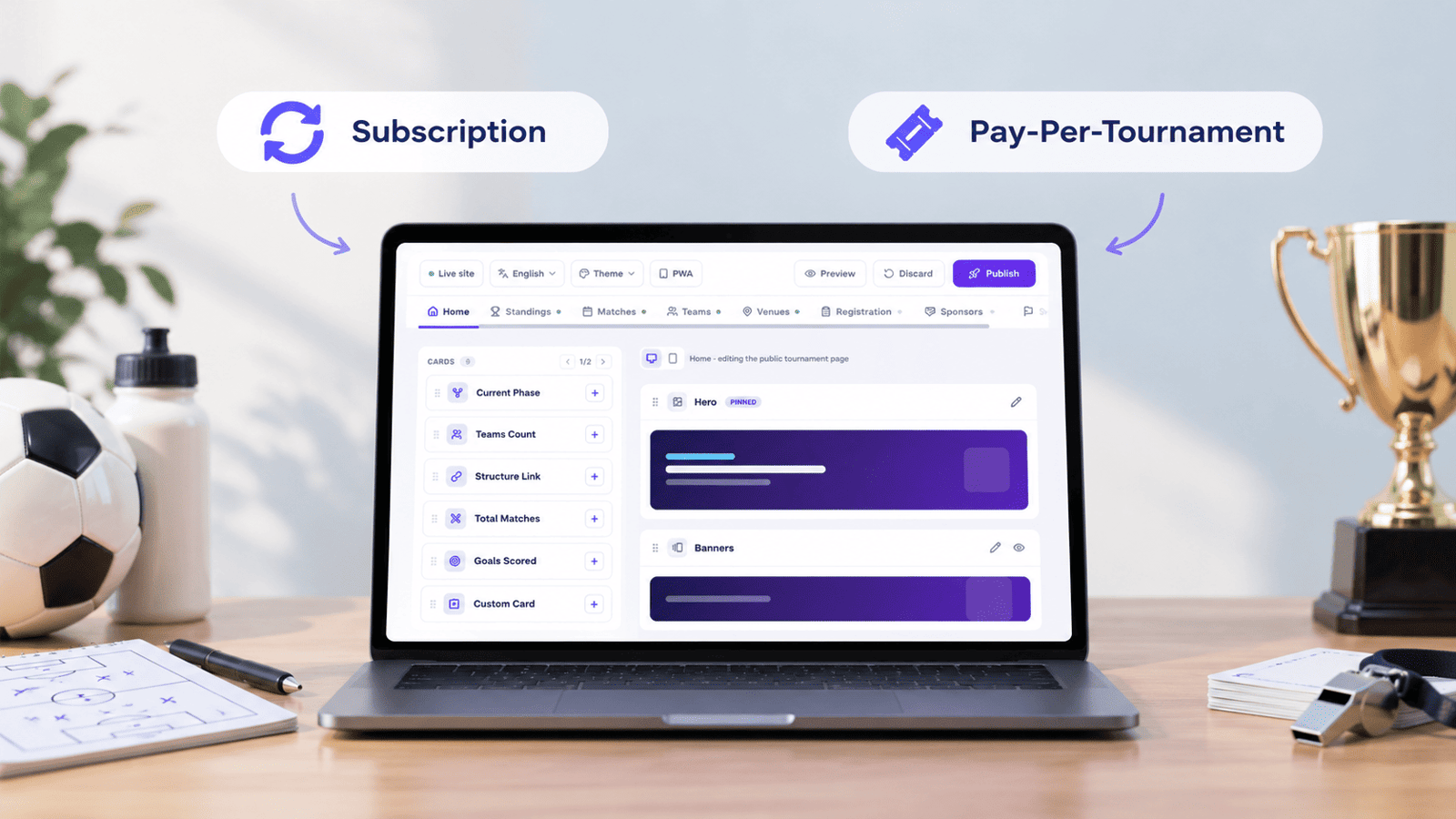
Tournament software is priced in two fundamentally different ways: a recurring subscription that bills monthly or annually regardless of how many events you actually run, or a pay-per-tournament model that charges once per event.
The sticker price alone is a misleading way to compare them: the cheaper option upfront often locks your results and public site the moment the event ends, while a pricier one-time purchase can stay live and editable indefinitely. The worked comparisons below use real vendor pricing, checked on 23 September 2026, with that ownership question priced in, not left for the fine print.
How the two models actually work
A subscription buys access to the platform for a fixed period, not to a specific event. You're billed whether you run one tournament that month or five, and the moment you stop paying, you typically lose the ability to edit, and sometimes even to view, anything you built. Vendors size these plans by feature tier, participant volume, or how many concurrent competitions you're allowed to run.
A pay-per-tournament model charges once when you create an event. That purchase usually buys a fixed team cap, a set of features, and, depending on the vendor, ongoing access to that event's data afterwards, though as you'll see below, "depending on the vendor" is doing a lot of work in that sentence. Run ten tournaments a year and you make ten separate purchases; run none in a quiet month and you owe nothing.
A third model sits alongside these two: per-participant fees, where the organiser pays a set amount for every team or player registered, on top of a base platform charge. It scales with turnout rather than with time or event count, which makes costs harder to predict at registration.
What each model costs in practice
Vendor | Pricing model | Entry price (checked 23 Sep 2026) | What changes as you scale |
|---|---|---|---|
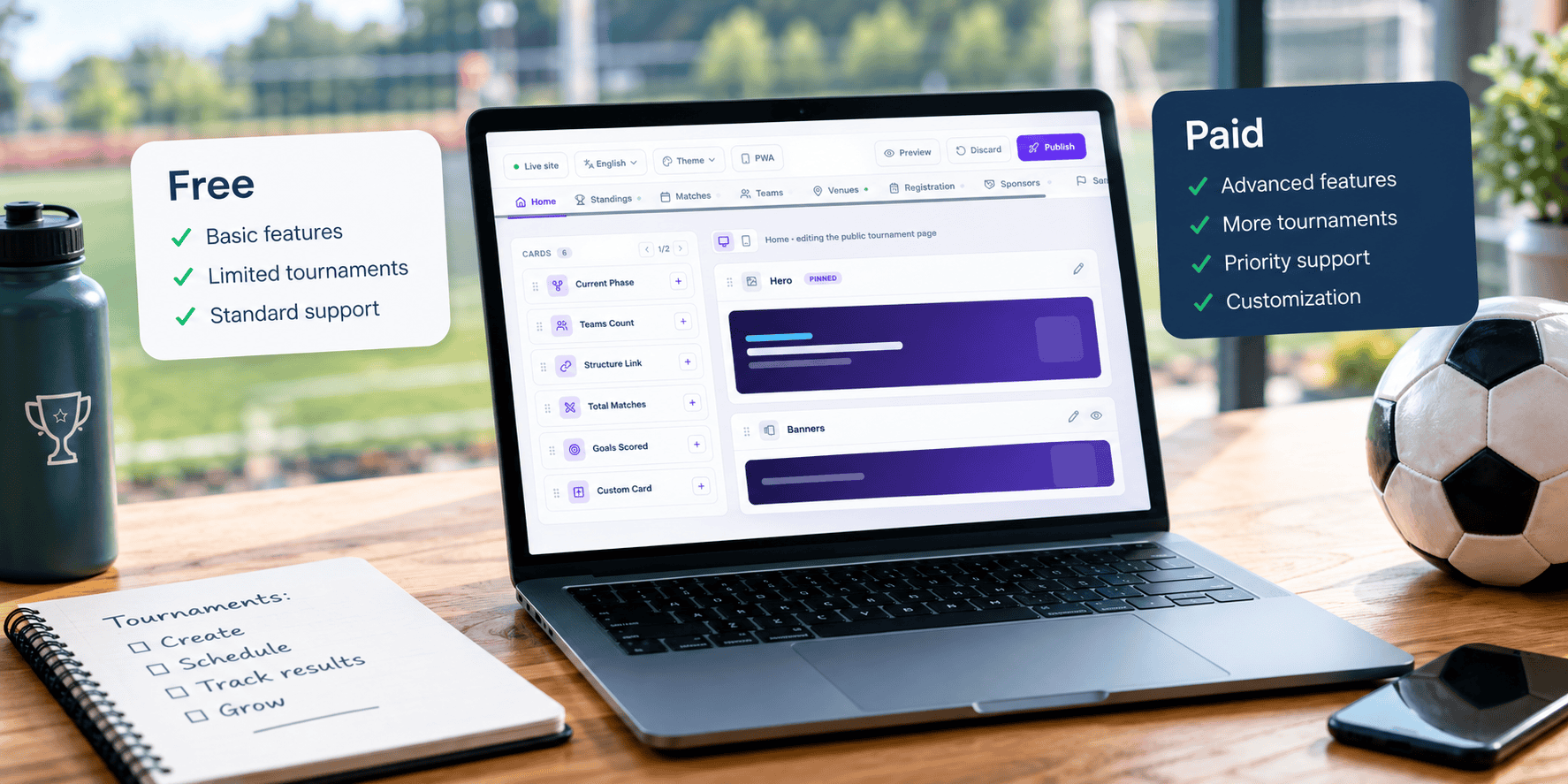
MyCup | Pay-per-tournament, one-time | Free (8 teams) · €50 Pro (50 teams) · €150 Premium (500 teams) · custom Enterprise | Each tournament is a separate purchase; the tournament stays live and editable afterwards at no extra cost, indefinitely |
Tournify | Pay-per-event, with a separate annual option | Free (8 teams) · €40 World Class (60 teams) · €120 Legendary (unlimited teams) | Per-event packages don't cover multiple separate tournaments; a season subscription is sold separately for high-frequency organisers |
Cup Manager | Per-participant fee | 44 NOK (≈€3.80) per registered team, plus payment transaction fees | Cost scales directly with turnout, a big cup costs proportionally more, with no volume ceiling |
Challonge (bracket tool, not a full platform) | Monthly/annual subscription | Free (256 participants, ad-supported) · $12/month or $6.99/month billed annually (Premier, 512 participants) | Billed continuously regardless of how many brackets you run that month; no registration forms, team logins or public site at any price |
Challonge is priced separately below because it isn't a like-for-like alternative to the other three. It's a strong, cheap bracket generator, but it doesn't do registration, team-side logins, a public tournament site or payment tracking. Comparing its subscription price against a full platform's per-event price answers a different question than the one most organisers are actually asking.
Annual cost by organiser type
These scenarios compare the three full tournament-management platforms (MyCup, Tournify, Cup Manager) on equal footing: same team counts, same event frequency, so the pricing model, not the event size, drives the difference. Each table also answers the question the price alone can't: what do you still have access to once the event is over? Assumptions: prices as checked above, no add-on services, no currency conversion beyond the approximate NOK/EUR rate shown.
Scenario A: one 60-team cup, run once a year
Vendor | Total cost | Stays editable after the event? | Notes |
|---|---|---|---|
MyCup | €150 | Yes, indefinitely | 60 teams exceeds the Pro cap, so Premium is required |
Tournify | €40 | No, locks once the event ends | World Class covers 60 teams exactly, cheapest option if you'll never revisit the event |
Cup Manager | ≈€225 plus fees | Not stated by vendor, confirm directly | 44 NOK × 60 teams, before transaction fees |
For a single event you'll genuinely never touch again, Tournify is the cheapest choice outright, there's no ownership premium worth paying for a tournament you're walking away from.
Scenario B: a club running 4 tournaments a year, ~40 teams each
Vendor | Total cost | Stays editable after each event? | Notes |
|---|---|---|---|
MyCup | €200/year | Yes, indefinitely | 4 × €50 Pro; all four stay live, correctable and linkable for good |
Tournify | €160/year | No, each locks at season's end | Reusing last year's fixture list as a starting point for next year needs a new purchase, the previous one can't be copied forward |
Cup Manager | ≈€602/year plus fees | Not stated by vendor, confirm directly | 44 NOK × 40 teams × 4 events |
Tournify is still €40 cheaper a year here. What that €40 doesn't buy: if a parent disputes a score in March for a tournament that finished in October, or you want to link last season's results from this year's site, Tournify's copy is already locked. MyCup's isn't.
Scenario C: an organisation running 12 tournaments a year, averaging 80 teams
Vendor | Total cost | Stays editable after each event? | Notes |
|---|---|---|---|
MyCup | Custom (Enterprise) or ≈€1,800/year at list price | Yes, indefinitely | 80 teams needs Premium per event at list price; this is exactly the volume Enterprise pricing is built for |
Tournify | ≈€1,440/year on the per-event route | No, each locks at season's end | 80 teams needs Legendary at €120/event; their separate annual subscription may undercut this further, get a quote |
Cup Manager | ≈€3,610/year plus fees | Not stated by vendor, confirm directly | Cost scales linearly with participants and becomes the most expensive option at real volume |
Read plainly: Tournify is cheaper than MyCup in every scenario above, and that's worth saying outright rather than dressing it up. The honest question isn't "which is cheaper", it's "what does a twelve-tournaments-a-year organisation lose by having each one lock the moment it ends". An organisation running events continuously is the one most likely to need to reopen, correct, cross-reference or point sponsors back to a past event, which is exactly what a locked tournament can't do.
Permanent archives and upgrade triggers
Tournify is explicit about the lock: its own help centre states that an event "will be locked" once it ends, and running the same fixture list again the following year requires a fresh purchase rather than a renewal or a copy. With most subscription tools, the same principle applies in a different shape, historical results and public pages generally stay accessible only while the subscription stays active. Confirm this directly with each vendor before you commit, since policies vary and aren't always stated plainly on a pricing page.
MyCup's one-time model keeps a purchased tournament editable and its public site live indefinitely, with no renewal required, for as long as the service operates. That's the trade you're actually making against Tournify's lower sticker price: pay a bit more per event, keep every event as a working, correctable, linkable asset rather than a frozen snapshot.
Which model actually costs less for you
A genuine one-off, never revisited again: pay-per-event with the lowest sticker price wins outright, Tournify included. Paying for permanence you won't use is just paying more.
Running events every season, year after year: the maths favours whichever option leaves you with something afterwards. A club or organisation that will want to correct a score, cite a past result, or simply keep a five-year history live is paying Tournify's lower price for a shrinking archive.
A season-long league that never really "ends": a subscription can make sense, since the platform is doing continuous work: standings, fixtures, communications, rather than hosting a single finished event.
High-frequency organisers running ten-plus events a year: compare a vendor's annual subscription against its per-event total directly; MyCup offers negotiated Enterprise pricing once volume passes what list pricing is built for, worth a conversation before assuming list price is your only option.
Any model charging per participant: budget for your highest plausible turnout, not your expected one. The bill moves with registrations, not with your forecast.
Frequently Asked Questions
Is MyCup cheaper than Tournify?
Is subscription or pay-per-tournament pricing cheaper for tournament software?
Do I lose access to old tournament results if I cancel a subscription?
What happens if my tournament grows past my plan's team limit?
Is a free tournament software plan actually free?